Study Mode
Instant feedback & explanations
See the answer and explanation after each choice.
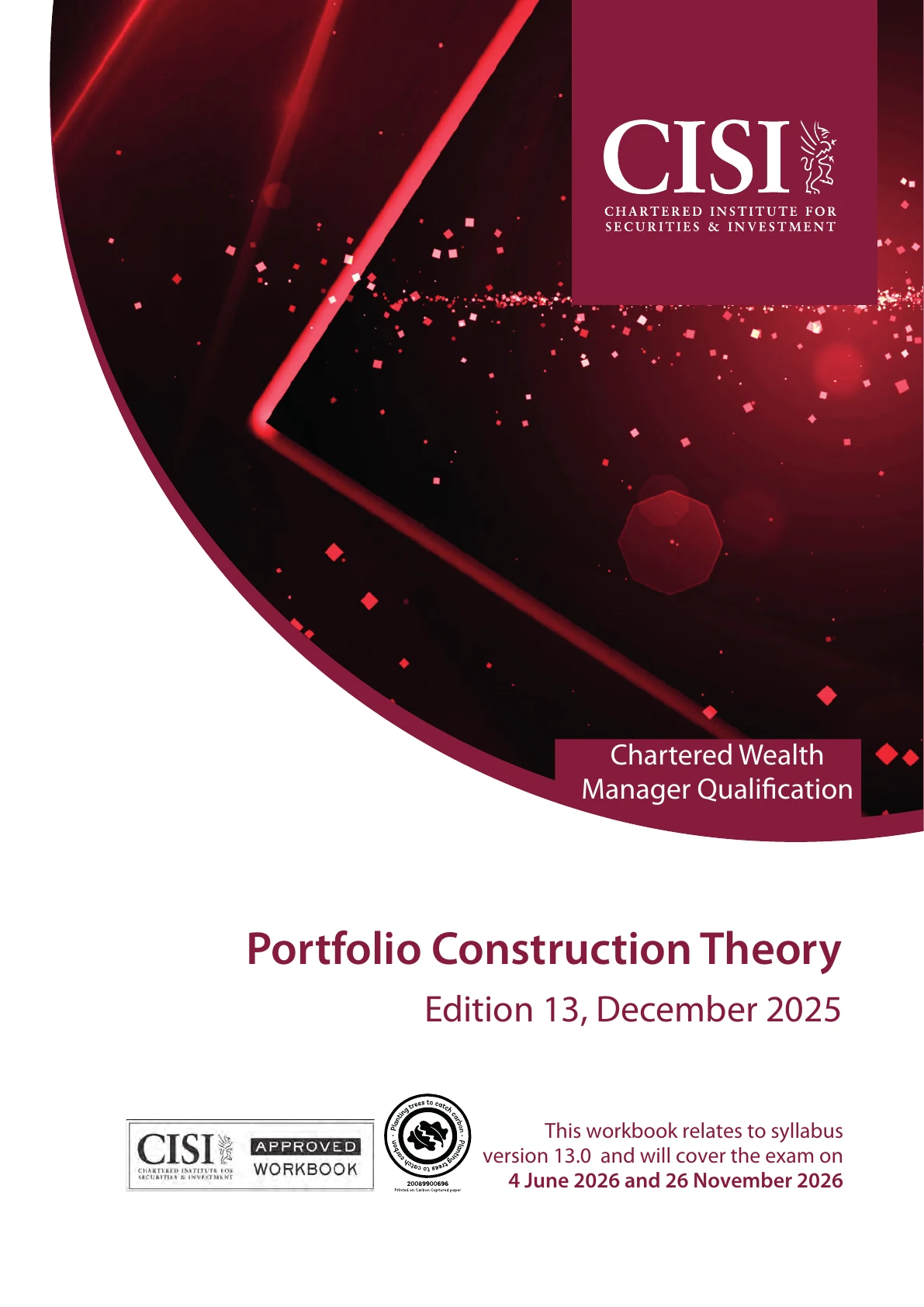
Structured preparation for Portfolio Construction Theory, the second unit in the three-unit CISI Chartered Wealth Manager Qualification.
Course syllabus information reviewed for 2026. Always check the awarding body’s latest official syllabus and candidate updates before booking or sitting your exam.
Listen to course modules on the go. Perfect for studying while driving or commuting.
* This is a chapter sample. All audio is available in the full version.
Portfolio Construction Theory, commonly shortened to PCT, is the second unit in the CISI Chartered Wealth Manager Qualification. It is a standalone Level 7 written examination rather than the complete Level 7 Diploma. Candidates progress from Financial Markets and then continue to Applied Wealth Management, subject to the current CISI route requirements.
The current syllabus contains ten learning outcomes across client risk and objectives, asset allocation, risk and return, asset pricing, efficient markets, behavioural finance, fund management, portfolio-level derivatives, performance measurement and UK taxation. The workbook uses the same ten-chapter structure. The syllabus also states that learning builds on Financial Markets and that aspects of the previous unit may be assessed in the PCT examination.
The formal assessment is a three-hour, 100-mark paper with three distinct sections. Section A is worth 20 marks and requires all multiple-choice questions. Section B is worth 40 marks and requires all questions. Section C is worth 40 marks and requires two written answers selected from three, worth 20 marks each.
The learning hub includes ten detailed chapter summaries, 140 flashcards, 152 rapid-reference and exam-trap entries, five 20-prompt practice sets, and a syllabus-grounded AI tutor. Separate Final Exam Practice simulates all three sections in one three-hour attempt: the 20 genuine multiple-choice items are objectively marked, compulsory written questions use answer boxes, and Section C enforces the choice of two answers from three. Written feedback is criteria-based practice, not an official CISI grade. Always confirm the latest official CISI syllabus and Candidate Update for your sitting; this page records the 2026 review year so the guidance remains useful when individual amendments are issued.
Prepare the different response skills needed for compulsory multiple choice, compulsory written questions and the choice in Section C.
Link client objectives and strategic allocation with investment theory, implementation, performance and tax consequences.
Study PCT as the middle unit while keeping its dependence on Financial Markets and progression to Applied Wealth Management clear.
Determine client circumstances, risk characteristics, investment objectives and suitable strategy while applying relevant duties.
Construct, implement and evaluate strategic and tactical allocation using asset-class evidence, constraints and portfolio tools.
Apply risk-free assets, inflation, foreign currency and time-period concepts to investment risk, return and performance.
Evaluate asset-pricing models and apply investment and valuation measures within portfolio construction.
Evaluate informational efficiency, market evidence, anomalies and their implications for investment approaches.
Explain behavioural-finance theory and evidence and evaluate implications for markets, clients and portfolio design.
Evaluate manager selection, active and index approaches, security selection, stewardship and responsible investment.
Appraise derivatives used to control portfolio risk, manage inflation exposure and protect portfolio value.
Apply benchmark selection and performance-attribution techniques to assess investment results.
Assess how UK taxation affects assets, funds, wrappers, investment returns, valuation and portfolio strategy.
Submitted directly to CISI Academy. These testimonials are not presented as independently verified by Trustpilot, Google, or another third-party platform.
Feedback shared by learners across CISI Academy courses.
The study material is very well organized. It is super helpful for exam preparation.
The mock exams are great. I failed once, used this site, and passed.
غيّرت هذه المنصة طريقة مذاكرتي تماماً. ملخصات الفصول ممتازة للمراجعة الأخيرة، ولوحة التحكم على الجوال تعمل بسلاسة.
I read the cheat sheet right before my exam, and several questions came straight from it. It really saved me!
The questions are very similar to the real test. I was worried about the time limit, but practicing with these mocks helped me manage my pace. Highly recommended!
I failed my first try because there was too much material. This broke down all the rules clearly. Highly recommend!
PCT is a three-hour, 100-mark examination. Section A is worth 20 marks and requires all multiple-choice questions, Section B is worth 40 marks and requires all questions, and Section C is worth 40 marks and requires two answers selected from three, worth 20 marks each.
No. It is the second unit. The qualification route also includes Financial Markets and Applied Wealth Management, subject to the current CISI entry and completion requirements.
Yes. The current official syllabus states that PCT builds on Financial Markets and candidates can be assessed on aspects of that previous unit.
The official learning material recommends approximately 200 hours for this unit, including workbook study, tuition where used, wider reading and examination practice.
The ten outcomes cover client risk and objectives, asset allocation, risk and return, pricing models, efficient markets, behavioural finance, fund management, portfolio-level derivatives, performance and UK taxation.
Yes. The learning hub includes ten chapter summaries, 140 flashcards, 152 rapid-reference and exam-trap entries, five 20-prompt practice sets and a syllabus-grounded AI tutor. The objective sets support knowledge and answer planning rather than claiming to reproduce or automatically grade the official written paper.
Try the free written practice paper and type your answers in guided mode. The course includes 1 written practice papers. The 15 multiple-choice questions below support answer planning; they do not by themselves reproduce the official written assessment.
Type your answers in guided practice. This paper provides 100 practice marks and 180 minutes. Open guided mode to try the free written question; marking guidance appears after submission.
Open Free Written PracticeThe multiple-choice preview below provides additional answer-planning practice.
Try 15 CISI Portfolio Construction Theory answer-planning prompts from Chapter 1: Fundamentals of Investment Theory
Practice CISI Portfolio Construction Theory written-exam answer planning with sample prompts and model structures, then unlock all five planning sets and complete syllabus coverage.
What is the purpose of a client fact-find in wealth management?
Portfolio construction begins with the client, not with a forecast or a favoured asset. The workbook's wealth-management process starts by gathering quantitative and qualitative information, developing or revising the investment policy, constructing the portfolio, monitoring it and evaluating performance. The stages form a feedback loop because client circumstances, market expectations and realised results can all require the policy or holdings to change.
The fact-find should establish age, wealth, life-cycle stage, jurisdiction, location, tax position, liquidity needs, time horizon, liabilities, knowledge, experience and responsible-investment preferences. These facts must be separated from the client's stated willingness to take risk. Risk tolerance describes psychological willingness;…
Open every chapter’s key areas, pitfalls, exam traps and key numbers.
Focus weak topics, learn with feedback, then switch to exam conditions.
Learn with feedback, then switch to exam conditions.
See the answer and explanation after each choice.
Use the timer, keep answers hidden, then review your result.

Build accurate recall and exam-day confidence with syllabus-aligned study tools, realistic practice and a course-grounded AI tutor.