Table of Contents
The CISI Global Financial Compliance (GFC) exam does not simply test whether you can recite regulatory definitions. It demands that you understand how major regulatory frameworks interconnect, why they exist, and how compliance professionals apply them in daily practice. For candidates preparing through our official CISI-accredited programme, grasping these frameworks at a structural level is the difference between passing and failing.
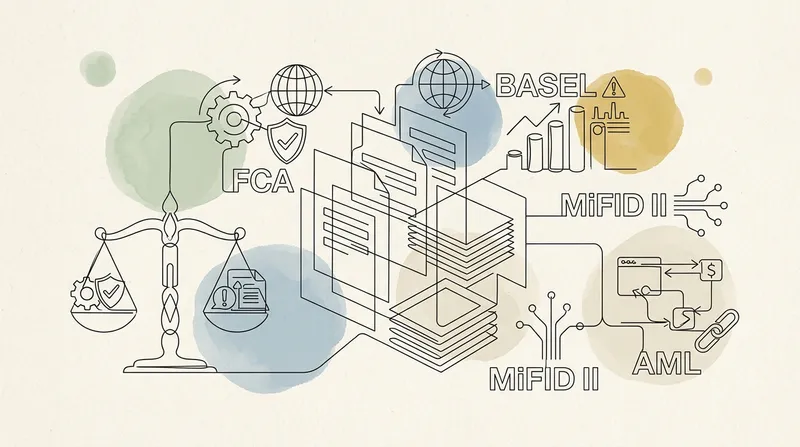
This article breaks down the five pillars of regulation that dominate the GFC syllabus — the FCA’s regulatory architecture, Basel capital accords, MiFID II investor protection rules, Anti-Money Laundering directives, and global sanctions regimes — and explains how each one appears in exam scenarios.
The FCA Regulatory Architecture
The Financial Conduct Authority (FCA) sits at the centre of UK financial regulation and is a critical topic in the GFC syllabus. Unlike prescriptive rules-based regulators, the FCA operates a principles-based approach, meaning firms must demonstrate they are meeting broad regulatory outcomes rather than merely ticking compliance boxes.
The GFC exam expects you to understand the FCA’s three operational objectives: consumer protection, market integrity, and promoting effective competition. Questions frequently test the distinction between these objectives and the FCA’s overarching strategic objective of ensuring markets function well.
Key areas that appear in exam scenarios include:
- The Approved Persons and Senior Managers & Certification Regime (SM&CR) — understanding individual accountability within regulated firms
- FCA enforcement powers — the authority to impose unlimited fines, withdraw authorisation, and prosecute criminal market abuse
- Principles for Businesses — the eleven core principles that all FCA-authorised firms must follow, from acting with integrity to treating customers fairly
The practical application questions often present a scenario where a firm has potentially breached one of these principles and ask you to identify which principle applies and what the regulatory consequence would be.
Basel Capital Accords: From II to III
The Basel framework is the global standard for banking regulation, and the GFC exam tests your understanding of how these accords protect the financial system from systemic risk. You do not need to perform complex capital calculations, but you must understand the structural logic behind the framework.
Basel II introduced the famous three-pillar approach:
- Pillar 1 — Minimum Capital Requirements: Banks must hold sufficient capital against credit, market, and operational risk
- Pillar 2 — Supervisory Review: Regulators assess whether a bank’s internal capital adequacy processes are robust
- Pillar 3 — Market Discipline: Banks must publicly disclose risk information to allow market participants to assess their stability
Basel III strengthened these requirements following the 2008 financial crisis. The GFC exam focuses on two critical additions:
- Liquidity Coverage Ratio (LCR) — requiring banks to hold enough high-quality liquid assets to survive a 30-day stress scenario
- Net Stable Funding Ratio (NSFR) — ensuring banks maintain stable funding sources relative to their long-term lending activities
- Counter-Cyclical Capital Buffer — additional capital that regulators can require during periods of excessive credit growth
Exam questions typically present a banking scenario and ask you to identify which Basel pillar or specific requirement is relevant to the situation described.
Free CISI GFC Regulatory Frameworks Decoded: FCA, Basel, MiFID II & AML Practice Questions & Exam Preview
Try 15 CISI GFC Regulatory Frameworks Decoded: FCA, Basel, MiFID II & AML practice questions from Money Laundering and Customer Due Diligence
Practice CISI GFC Regulatory Frameworks Decoded: FCA, Basel, MiFID II & AML exam questions with answers and explanations. The full course includes 5 mock exams and complete syllabus coverage.
Exam Preview
Which organization conducts mutual evaluations of countries to assess their compliance with AML/CFT standards?
Flashcards
Financial Regulation
Focus Learn
- Objectives and benefits of financial regulation: investor protection, market confidence, financial stability, reduction of financial crime.
- Differences between rules-based regulation (prescriptive, letter of the law) and principles-based regulation (outcomes-focused, spirit of the law).
- Roles of IOSCO (securities standards), FATF (AML/CFT standards, 40 Recommendations), Basel Committee (banking capital requirements — Basel III), and FSB (systemic risk, G20 coordination).
- The role of self-regulatory organisations (SROs) complementing state regulators.
- Cross-border regulatory cooperation — Memoranda of Understanding (MoUs) between regulators.
- Extra-territorial application of regulations (e.g., US FATCA, UK Bribery Act).
This chapter examines the global regulatory framework for financial services, covering the objectives and benefits of regulation including investor protection, market confidence, financial stability, and the reduction of financial crime. It contrasts rules-based regulation (prescriptive, detailed requirements) with principles-based regulation (outcome-focused, flexible application). Key international bodies include IOSCO (International Organization of Securities Commissions), which sets global securities regulation standards, FATF (Financial Action Task Force) for AML/CFT standards, the Basel Committee for banking supervision, and the FSB (Financial Stability Board) for systemic risk monitoring. The chapter also covers the role of self-regulatory organisations (SROs) and the importance of…
Unlock all Focus Learn
Open every chapter’s key areas, pitfalls, exam traps and key numbers.
MiFID II: Investor Protection in Practice
The Markets in Financial Instruments Directive II (MiFID II) is one of the most heavily tested regulatory frameworks in the GFC exam. Rather than memorising every article of the directive, focus on understanding the practical investor protection mechanisms it establishes.
The cornerstone of MiFID II is its three-tier client classification system: Retail clients receive the highest level of protection, Professional clients receive intermediate protection, and Eligible Counterparties receive the least. The classification directly determines which conduct of business rules apply — a critical concept for exam scenarios.
Key MiFID II provisions that regularly appear in GFC questions include:
- Suitability and Appropriateness Tests: suitability assesses a recommendation or portfolio service against objectives, financial situation, knowledge and experience; appropriateness asks whether a client understands the risks of a relevant non-advised product and is not a shortened suitability test
- Best Execution — the obligation to achieve the best possible result when executing client orders across multiple factors including price, speed, and likelihood of settlement
- Product Governance — manufacturers and distributors of financial products must define target markets and ensure products reach appropriate investors
- Cost Transparency — firms must provide clear, upfront disclosure of all costs and charges, both before and after the transaction
AML Directives and the Risk-Based Approach
Anti-Money Laundering (AML) regulation forms a substantial portion of the GFC syllabus. The exam tests your understanding of international AML standards, primarily driven by the Financial Action Task Force (FATF) recommendations, as well as regional implementations like the EU Anti-Money Laundering Directives.
The central concept you must master is the risk-based approach. Rather than applying identical checks to every client, regulated firms must assess the level of money laundering risk and apply controls proportionally:
- Simplified Due Diligence (SDD) for low-risk clients and products
- Standard Customer Due Diligence (CDD) as the baseline requirement, including verifying client identity and understanding the purpose of the business relationship
- Enhanced Due Diligence (EDD) for higher-risk situations, including Politically Exposed Persons (PEPs), clients from high-risk jurisdictions, and complex or unusually large transactions
The exam frequently tests Suspicious Activity Reports (SARs) — when they must be filed, who files them, and critically, the tipping-off offence that prohibits disclosing to a client that a report has been made. Scenario questions in this area often present a compliance officer with a suspicious transaction and ask you to identify the correct course of action.
Global Sanctions and Cross-Border Compliance
The final regulatory pillar in the GFC syllabus covers sanctions regimes and the challenges of maintaining compliance across multiple jurisdictions. This is an increasingly important area as geopolitical developments continuously reshape the sanctions landscape.
Candidates must understand:
- The difference between targeted sanctions (freezing assets of specific individuals or entities) and sectoral sanctions (restricting trade in particular economic sectors)
- The role of bodies like the UN Security Council, EU Council, and OFAC (US Office of Foreign Assets Control) in imposing and administering sanctions
- The compliance obligation to screen clients and transactions against sanctions lists and the severe penalties for breaches, which can include criminal prosecution
Cross-border compliance questions often present scenarios where a transaction touches multiple jurisdictions with conflicting regulations, testing your ability to identify the most restrictive applicable requirement.
Building Your Regulatory Framework Mastery
Success in the CISI GFC exam requires more than surface-level familiarity with these frameworks. Each regulatory regime exists for specific reasons — protecting consumers, preventing systemic risk, combating financial crime — and the exam tests whether you understand these purposes and can apply the rules to realistic compliance scenarios.
Focus your preparation on scenario-based practice. For every framework, ask yourself: What problem does this regulation solve? What would happen if a firm failed to comply? Which specific provision applies to this situation? This analytical approach mirrors how exam questions are structured and will serve you well beyond the test itself in your compliance career.
Our CISI-accredited GFC preparation platform provides structured coverage of every regulatory framework discussed here, complete with scenario-based practice questions that mirror the exam format. As an official CISI Accredited Training Partner, we ensure our materials align directly with the current GFC syllabus.
Frequently Asked Questions
1 What regulatory frameworks are tested in the CISI GFC exam?
The CISI GFC exam covers a broad range of international regulatory frameworks including the FCA regulatory architecture, Basel capital accords (Basel II and III), MiFID II investor protection rules, EU Anti-Money Laundering Directives, and global sanctions regimes.
2 How deeply does the GFC exam test knowledge of Basel III?
Candidates must understand the core pillars of Basel III — minimum capital requirements, supervisory review, and market discipline — as well as practical implications like the Liquidity Coverage Ratio (LCR) and Net Stable Funding Ratio (NSFR). Detailed mathematical calculations are not required.
3 Is the FCA Handbook examinable in the CISI GFC?
Yes. The CISI GFC syllabus expects candidates to understand the FCA's regulatory objectives (consumer protection, market integrity, and competition), its enforcement powers, and how the FCA's principles-based approach differs from rules-based regulation.
4 What AML knowledge is required for the CISI GFC exam?
The exam tests your understanding of Customer Due Diligence (CDD), Enhanced Due Diligence (EDD), Suspicious Activity Reports (SARs), Politically Exposed Persons (PEPs), and the risk-based approach mandated by international AML directives including FATF recommendations.
5 How does MiFID II appear in the CISI GFC exam?
MiFID II questions focus on investor protection measures such as suitability assessments, best execution obligations, product governance requirements, and cost transparency rules. Candidates should understand how these provisions apply in practice across different client categories.
Ready to Prepare for Your Exam?
Prepare with syllabus-aligned study tools, realistic practice and course-grounded AI support.
Explore Courses