
Table of Contents
- • The Dual Regulatory Environment: An Overview
- - 1. Mainland UAE Regulation (UAE CMA (formerly SCA) and CBUAE)
- - 2. Financial Free Zones (DFSA and DIFC)
- • Key Differences Tested in the Exam
- - A. Licensing and Incorporation
- - B. Client Classification
- - C. The Concept of “In or From” the DIFC
- - D. Anti-Money Laundering (AML)
- • Exam Strategy: Spotting the Trap
CISI UAE FRR
Explore the study tools and practical exam preparation built for this course.
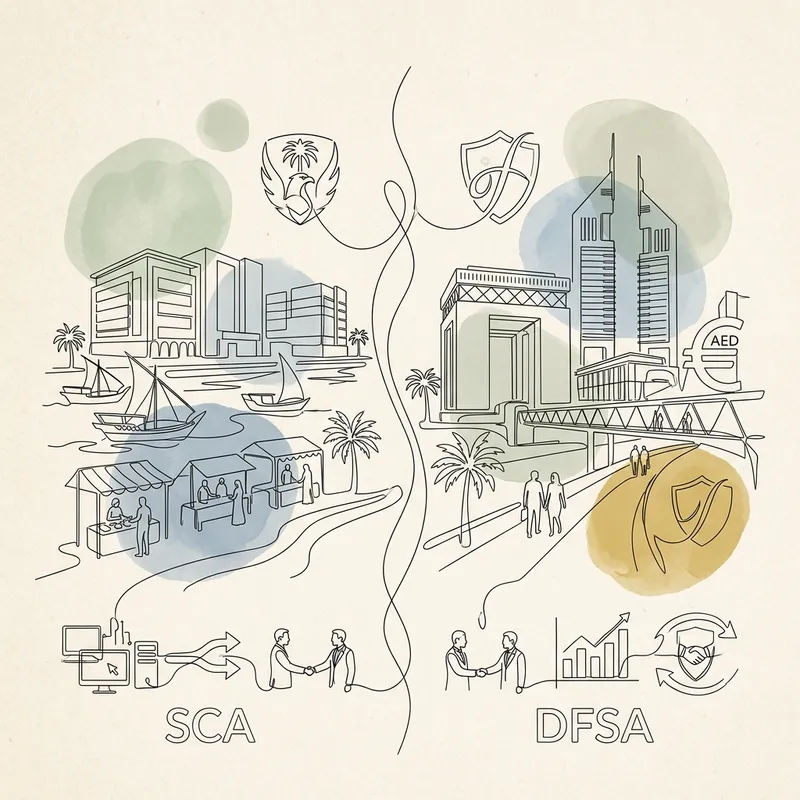
The United Arab Emirates presents a unique and dynamic regulatory landscape for financial professionals. Unlike many countries with a single, unified financial regulator, the UAE operates on a “dual regulatory” system. This structure is a frequent stumbling block for candidates taking the CISI UAE Financial Rules and Regulations (UAE FRR) exam.
Understanding the jurisdictional boundaries, differing terminologies, and specific rules of the UAE Capital Market Authority (formerly the Securities and Commodities Authority) (UAE CMA (formerly SCA)) versus the Dubai Financial Services Authority (DFSA) is not just helpful—it is absolutely essential for passing the exam.
The Dual Regulatory Environment: An Overview
To grasp the regulatory framework of the UAE, you must first understand the geographical and legal distinction between the “Mainland” and “Financial Free Zones.”
1. Mainland UAE Regulation (UAE CMA (formerly SCA) and CBUAE)
The mainland UAE is governed by federal laws. The primary regulators here are:
- The Central Bank of the UAE (CBUAE): Regulates banks, exchange houses, and finance companies.
- The UAE Capital Market Authority (formerly the Securities and Commodities Authority) (UAE CMA (formerly SCA)): Regulates capital markets, securities, commodities, and the licensing of financial brokers and investment advisors operating outside the financial free zones.
2. Financial Free Zones (DFSA and DIFC)
To attract foreign investment, the UAE established Financial Free Zones with their own independent civil and commercial laws (based closely on English Common Law). The most prominent is the Dubai International Financial Centre (DIFC).
- The Dubai Financial Services Authority (DFSA): The independent regulator for all financial and ancillary services conducted in or from the DIFC.
Note: The Abu Dhabi Global Market (ADGM) is another major financial free zone with its own regulator (FSRA), but the CISI UAE FRR exam primarily focuses on the DFSA/DIFC alongside UAE CMA (formerly SCA).
Key Differences Tested in the Exam
The CISI exam will frequently test your ability to distinguish between these two regimes. Here are the core areas where candidates often get confused.
A. Licensing and Incorporation
- DIFC/DFSA: In the DIFC, the Registrar of Companies (RoC) handles the legal incorporation of the business entity. The DFSA is solely responsible for granting the financial services license.
- Mainland/UAE CMA (formerly SCA): A firm must typically get a commercial license from the local Department of Economic Development (DED) and a financial license from the UAE CMA (formerly SCA) or the Central Bank.
B. Client Classification
Both regulators require firms to classify clients to ensure appropriate levels of protection, but their terminology and thresholds differ.
- DFSA (DIFC): Classifies clients primarily as Retail Clients (requiring the highest protection), Professional Clients (based on net asset thresholds or experience), and Market Counterparties (institutional players).
- UAE CMA (formerly SCA) (Mainland): Uses similar concepts but often refers to them under different federal resolutions, distinguishing between standard investors and “Qualified Investors.”
Free CISI UAE FRR Practice Questions & Exam Preview
Try 15 CISI UAE FRR practice questions from Investment Funds
Practice CISI UAE FRR exam questions with answers and explanations. The full course includes 5 mock exams and complete syllabus coverage.
Exam Preview
A private investment fund is preparing a promotional campaign. Which advertising restriction applies to that campaign?
Flashcards
When was the SCA established and where is it headquartered?
Focus Learn
- Establishment and functions of the SCA under Federal Law No. 4 of 2000
- SCA Board: appointed by Cabinet resolution for 4-year terms, renewable once
- Five licence categories and their paid-up capital requirements (AED 30M, 50M, 50M, 5M)
- Corporate governance requirements for PJSCs
- CISI Code of Conduct eight principles
- SCA powers: licensing, investigation, enforcement, penalties
- Related-party transaction 5% threshold requiring General Assembly approval
- Gift restrictions: AED 500 or less for symbolic gifts
- SCA budget timeline: approved 1 month before fiscal year; final accounts within 90 days
1. Regulatory Foundation
This chapter establishes the UAE's regulatory foundation through Federal Law No. 4 of 2000, which created the Securities & Commodities Authority (SCA).
The SCA operates as an independent public authority in Abu Dhabi with its own legal personality, full financial, and administrative independence. It is prohibited from entering into commercial activities, having private interests of its own in any undertaking, or owning/issuing securities.
2. SCA Board & Operations
The SCA is managed by a Board of Directors:
- Constitution: Appointed by resolution of the Cabinet of Ministers.
- Tenure: Members are appointed for 4 years, renewable once only.
- Meetings: The Board must meet at least once every 2 months. Emergency meetings c…
Unlock all Focus Learn
Open every chapter’s key areas, pitfalls, exam traps and key numbers.
C. The Concept of “In or From” the DIFC
A critical phrase in the DFSA rulebook is “in or from the DIFC.” If a firm is based in the DIFC, it is regulated by the DFSA. However, this does not mean it can freely market its services to residents in mainland Dubai or Abu Dhabi. Providing financial services to mainland residents usually requires explicit authorization from the UAE CMA (formerly SCA) or Central Bank, or must fall under very strict “reverse solicitation” exemptions. This jurisdictional boundary is a highly tested concept.
D. Anti-Money Laundering (AML)
This is the one area where the lines blur—in a good way. Federal Criminal Law applies everywhere. The UAE’s Federal AML and Counter-Terrorist Financing (CTF) laws apply across the entire country, including the DIFC. While the DFSA has its own AML rulebook that details how firms should implement controls, the underlying criminal offenses and reporting obligations to the UAE Financial Intelligence Unit (FIU) are governed by federal law.
Exam Strategy: Spotting the Trap
When taking the UAE FRR exam, pay close attention to the wording of the scenario:
- “A firm located in Dubai…” usually implies mainland Dubai (UAE CMA (formerly SCA)/CBUAE).
- “An Authorized Firm in the DIFC…” immediately tells you the DFSA rules apply.
If an exam question asks about incorporating a company in the DIFC, look for “Registrar of Companies,” not DFSA. If the question asks about investigating insider trading on the Dubai Financial Market (DFM), look for “UAE CMA (formerly SCA).”
By clearly drawing the line between mainland and free zone jurisdictions in your mind, you will easily avoid the common traps set by the examiners and secure those crucial passing marks.
Frequently Asked Questions
1 What is the main difference between UAE CMA (formerly SCA) and DFSA?
UAE CMA (formerly SCA) (UAE Capital Market Authority (formerly the Securities and Commodities Authority)) regulates the mainland UAE financial markets, while the DFSA (Dubai Financial Services Authority) is the independent regulator specifically for the Dubai International Financial Centre (DIFC) free zone.
2 Does the CISI UAE FRR exam cover both regulators?
Yes, the UAE FRR syllabus is designed to test your knowledge of the dual regulatory environment in the UAE, meaning you will be tested on both UAE CMA (formerly SCA) and DFSA regulations.
3 Can a DFSA-regulated firm operate in mainland UAE?
Generally, no. A firm licensed by the DFSA within the DIFC cannot conduct financial services in the broader UAE mainland without obtaining the necessary licenses from the Central Bank or UAE CMA (formerly SCA), unless specific cross-border exemptions apply.
4 Which regulator handles AML (Anti-Money Laundering) laws?
AML laws are federal laws that apply across the entire UAE (mainland and free zones). Both UAE CMA (formerly SCA) and DFSA enforce these federal laws within their respective jurisdictions, alongside their own specific AML rulebooks.
5 Why do I need to know the differences for the exam?
Exam questions often present scenarios designed to trick you by mixing the terminology or jurisdictions of UAE CMA (formerly SCA) and DFSA. Knowing the exact boundaries of their authority is critical to selecting the correct answer.
Ready to Prepare for Your Exam?
Prepare with syllabus-aligned study tools, realistic practice and course-grounded AI support.
Explore Courses