Study Mode
Instant feedback & explanations
See the answer and explanation after each choice.
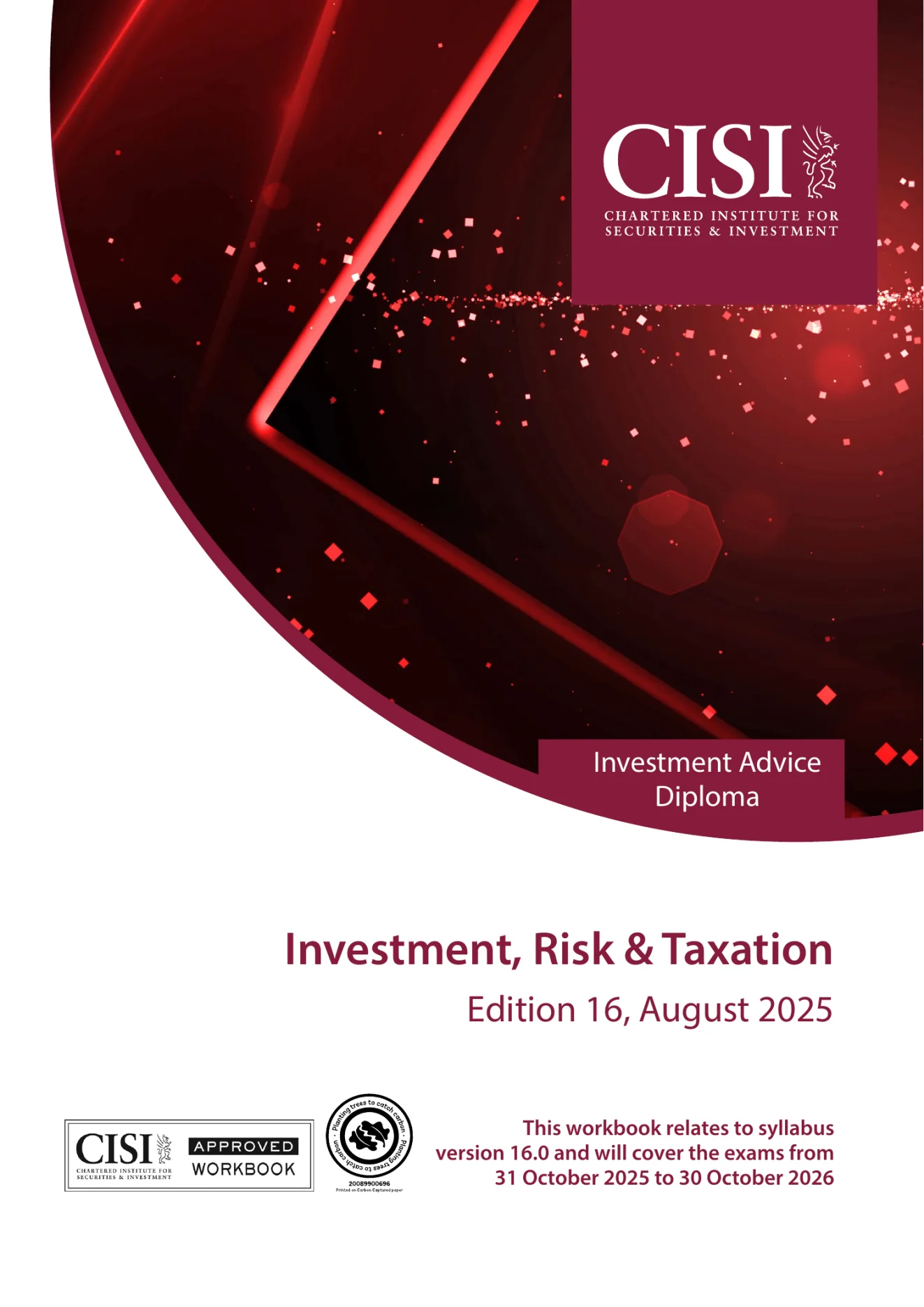
Structured preparation for the CISI Level 4 Investment, Risk and Taxation unit, aligned to Version 16 and the current Candidate Update for exams through 30 November 2026.
Course syllabus information reviewed for 2026. Always check the awarding body’s latest official syllabus and candidate updates before booking or sitting your exam.
Listen to course modules on the go. Perfect for studying while driving or commuting.
* This is a chapter sample. All audio is available in the full version.
Investment, Risk and Taxation is one of the two core Level 4 units in the CISI Investment Advice Diploma. Candidates combine it with UK Regulation and Professional Integrity and one technical unit: Securities, Derivatives, or Financial Planning and Advice. The same unit also combines with Financial Planning and Advice in the CISI Certificate in Paraplanning.
The syllabus moves from asset classes and fundamental analysis through investment risk, UK taxation, investment products, portfolio construction, the advice process and portfolio review. The course follows Version 16, maps all 80 questions across the eight official elements and incorporates the CISI Candidate Update posted in June 2026, including its extended final exam date of 30 November 2026.
Study all 140 granular objectives with eight detailed chapters, 245 recall and formula cards, and 223 searchable references including 70 worked calculations. Four original 80-question mocks progress from foundations to final practice; a fifth paper mixes 20 questions from each. Tax exercises state 2025/26 explicitly, while dated updates distinguish later rule changes.
Understand exactly where this unit fits within the Investment Advice Diploma and related CISI qualification routes.
Prioritise all 80 questions using the eight published syllabus elements and their exact weightings.
Prepare against Version 16 with the applicable 2026 formula, tax, options, product and portfolio updates.
Cash, fixed-income securities, equities, property and alternative assets, including their characteristics, valuation, risks and returns.
Company accounts and valuation, economic concepts, macroeconomic indicators, policy and the influences on asset classes.
Time value of money, return measurement, investment risk, portfolio theory, behavioural finance and statistical analysis.
UK income tax, investment income, NICs, CGT, IHT, residence, stamp taxes, VAT, corporation tax, compliance and planning.
Collective and closed-ended investments, wrappers, insurance bonds, private markets, derivatives, structured products and pensions.
Asset allocation, diversification, investment theory, product selection, research, charges and management styles.
Client information, needs, objectives, capacity for loss, risk profiling, suitability, recommendations, disclosure and implementation.
Performance measurement, attribution, benchmarks, appraisal, rebalancing and ongoing client and portfolio review.
The Level 4 assessment contains 80 scored multiple-choice questions, lasts 120 minutes and has a 70% pass mark: 56 correct answers. Unidentified trial questions can add proportionate time.
The page follows Version 16 and the current CISI Candidate Update. The update extends the final exam date for this version to 30 November 2026.
Not by itself. The IAD requires this unit, UK Regulation and Professional Integrity, and one technical unit: Securities, Derivatives, or Financial Planning and Advice.
Yes. CISI also uses Investment, Risk and Taxation with Financial Planning and Advice in the Certificate in Paraplanning.
Taxation of Investors and Investments carries 16 of 80 questions. Asset Classes, Investment Products and the Process of Giving Investment Advice each carry 13.
Eight detailed chapter summaries, 245 recall and formula cards, 223 searchable references including 70 worked calculations, a syllabus-grounded AI tutor and five full 80-question papers. The first four contain 320 original questions; the fifth is an equal mixed sample. Eight English chapter revision summaries are available in male and female voices.
Always confirm the latest official CISI syllabus and Candidate Updates for your 2026 sitting. This page records Version 16 and the applicable update verified on 19 September 2026.
Yes! Test your knowledge and review detailed explanations with the free CISI Investment, Risk and Taxation Mock Exam Preview below. It contains 15 exam-style questions from one named syllabus topic; the full course provides complete mock exams and syllabus coverage.
Try 15 CISI Investment, Risk and Taxation practice questions from Chapter 4: Taxation of Investors and Investments
Practice CISI Investment, Risk and Taxation exam questions with answers and explanations. The full course includes 5 mock exams and complete syllabus coverage.
What is the official scored-paper pass boundary?
Start with the economic claim you own: a deposit, debt claim, residual equity interest, physical asset or contractual exposure. Compare the source of income, potential capital change, liquidity, counterparty and market risks. An asset's name alone does not establish protection or suitability. The sections below distinguish the major asset classes and connect valuation methods to their assumptions.
A current account serves payments; instant-access savings prioritise availability. A notice account requires advance notice or a stated penalty, while a fixed-term deposit commits money for an agreed term under its rate terms. Money-market deposits have specified dealing sizes and maturity terms. NS&I products have their own access, eligibility and tax rules and Treasury b…
Open every chapter’s key areas, pitfalls, exam traps and key numbers.
Focus weak topics, learn with feedback, then switch to exam conditions.
Learn with feedback, then switch to exam conditions.
See the answer and explanation after each choice.
Use the timer, keep answers hidden, then review your result.

Build accurate recall and exam-day confidence with syllabus-aligned study tools, realistic practice and a course-grounded AI tutor.